Skeletal
but recognizable
sanctuary
ghosted
in stone
once engaging
minds and hearts
worshiping.
Now
engaging
brilliant blue sky.
No laughter
echoing
children's faith.
Children's
drawings
dust.
Absent
life,
only
acrid
smoke
lives on.
Organ
dessicated,
piped faith
silenced
only
enfleshed
synapses
and
vocal memory
hold
the
songs.
Sacred dance
of worship
will be
danced
by
wind
with
partner
of
wafting smoke
now.
My mother was...
my parents were...
my baby took
his
first steps
there
in
stone walls
now
absent
sacred glass.
You sheltered
our God-
sized
hopes.
Where do you blow
Holy Spirit
when
your
absence is marked
in ashes,
not on foreheads
but on
distraught
earth?
All is lost
all is lost.
Grieving
stains
black
cheeks
with
small
streams
of tears.
But...
I
remember
our faith
was
never
contained
in wood
and glass
and stone
after all.
It
lives
in my
heart
when
it
sees
a blue sky
or
when it
touches
you.
Jennifer's Mind-weavings on grace in life, faith, and motherhood.
Search This Blog
Wednesday, March 14, 2012
Sky Colored Ashes (For Ada 1st United Methodist Church and all Ghosts of Christian Faith)
Labels:
church burned,
death,
fire,
grieving,
hope,
loss,
resurrection
Saturday, February 25, 2012
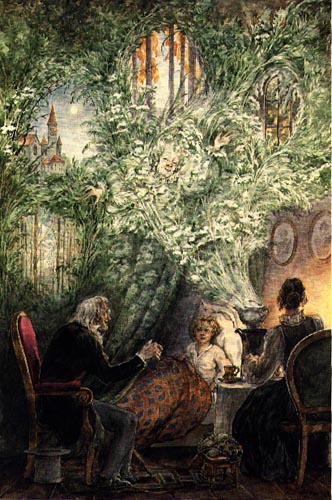
The Little Elder Tree Mother by Hans Christian Andersen (1845)
There was once a little boy who had caught cold; he had gone out and got wet feet. Nobody had the least idea how it had happened; the weather was quite dry. His mother undressed him, put him to bed, and ordered the teapot to be brought in, that she might make him a good cup of tea from the elder-tree blossoms, which is so warming. At the same time, the kind-hearted old man who lived by himself in the upper storey of the house came in; he led a lonely life, for he had no wife and children; but he loved the children of others very much, and he could tell so many fairy tales and stories, that it was a pleasure to hear him.
“Now, drink your tea,” said the mother; “perhaps you will hear a story.”
“Yes, if I only knew a fresh one,” said the old man, and nodded smilingly. “But how did the little fellow get his wet feet?” he then asked.
“That,” replied the mother, “nobody can understand.”
“Will you tell me a story?” asked the boy.
“Yes, if you can tell me as nearly as possible how deep is the gutter in the little street where you go to school.”
“Just half as high as my top-boots,” replied the boy; “but then I must stand in the deepest holes.”
“There, now we know where you got your wet feet,” said the old man. “I ought to tell you a story, but the worst of it is, I do not know any more.”
“You can make one up,” said the little boy. “Mother says you can tell a fairy tale about anything you look at or touch.”
“That is all very well, but such tales or stories are worth nothing! No, the right ones come by themselves and knock at my forehead saying: ‘Here I am.’”
“Will not one knock soon?” asked the boy; and the mother smiled while she put elder-tree blossoms into the teapot and poured boiling water over them. “Pray, tell me a story.”
“Yes, if stories came by themselves; they are so proud, they only come when they please.—But wait,” he said suddenly, “there is one. Look at the teapot; there is a story in it now.”
And the little boy looked at the teapot; the lid rose up gradually, the elder-tree blossoms sprang forth one by one, fresh and white; long boughs came forth; even out of the spout they grew up in all directions, and formed a bush—nay, a large elder tree, which stretched its branches up to the bed and pushed the curtains aside; and there were so many blossoms and such a sweet fragrance! In the midst of the tree sat a kindly-looking old woman with a strange dress; it was as green as the leaves, and trimmed with large white blossoms, so that it was difficult to say whether it was real cloth, or the leaves and blossoms of the elder-tree.
“What is this woman’s name?” asked the little boy.
“Well, the Romans and Greeks used to call her a Dryad,” said the old man; “but we do not understand that. Out in the sailors’ quarter they give her a better name; there she is called elder-tree mother.Now, you must attentively listen to her and look at the beautiful elder-tree.
“Just such a large tree, covered with flowers, stands out there; it grew in the corner of an humble little yard; under this tree sat two old people one afternoon in the beautiful sunshine. He was an old, old sailor, and she his old wife; they had already great-grandchildren, and were soon to celebrate their golden wedding, but they could not remember the date, and the elder-tree mother was sitting in the tree and looked as pleased as this one here. ‘I know very well when the golden wedding is to take place,’ she said; but they did not hear it—they were talking of bygone days.
“‘Well, do you remember?’ said the old sailor, ‘when we were quite small and used to run about and play—it was in the very same yard where we now are—we used to put little branches into the ground and make a garden.’
“‘Yes,’ said the old woman, ‘I remember it very well; we used to water the branches, and one of them, an elder-tree branch, took root, and grew and became the large tree under which we are now sitting as old people.’
“‘Certainly, you are right,’ he said; ‘and in yonder corner stood a large water-tub; there I used to sail my boat, which I had cut out myself—it sailed so well; but soon I had to sail somewhere else.’
“‘But first we went to school to learn something,’ she said, ‘and then we were confirmed; we both wept on that day, but in the afternoon we went out hand in hand, and ascended the high round tower and looked out into the wide world right over Copenhagen and the sea; then we walked to Fredericksburg, where the king and the queen were sailing about in their magnificent boat on the canals.’
“‘But soon I had to sail about somewhere else, and for many years I was travelling about far away from home.’
“‘And I often cried about you, for I was afraid lest you were drowned and lying at the bottom of the sea. Many a time I got up in the night and looked if the weathercock had turned; it turned often, but you did not return. I remember one day distinctly: the rain was pouring down in torrents; the dust-man had come to the house where I was in service; I went down with the dust-bin and stood for a moment in the doorway, and looked at the dreadful weather. Then the postman gave me a letter; it was from you. Heavens! how that letter had travelled about. I tore it open and read it; I cried and laughed at the same time, and was so happy! Therein was written that you were staying in the hot countries, where the coffee grows. These must be marvellous countries. You said a great deal about them, and I read all while the rain was pouring down and I was standing there with the dust-bin. Then suddenly some one put his arm round my waist—’
“‘Yes, and you gave him a hearty smack on the cheek,’ said the old man.
“‘I did not know that it was you—you had come as quickly as your letter; and you looked so handsome, and so you do still. You had a large yellow silk handkerchief in your pocket and a shining hat on. You looked so well, and the weather in the street was horrible!’
“‘Then we married,’ he said. ‘Do you remember how we got our first boy, and then Mary, Niels, Peter, John, and Christian?’
‘Oh yes; and now they have all grown up, and have become useful members of society, whom everybody cares for.’
“‘And their children have had children again,’ said the old sailor. ‘Yes, these are children’s children, and they are strong and healthy. If I am not mistaken, our wedding took place at this season of the year.’
“‘Yes, to-day is your golden wedding-day,’ said the little elder-tree mother, stretching her head down between the two old people, who thought that she was their neighbour who was nodding to them; they looked at each other and clasped hands. Soon afterwards the children and grandchildren came, for they knew very well that it was the golden wedding-day; they had already wished them joy and happiness in the morning, but the old people had forgotten it, although they remembered things so well that had passed many, many years ago. The elder-tree smelt strongly, and the setting sun illuminated the faces of the two old people, so that they looked quite rosy; the youngest of the grandchildren danced round them, and cried merrily that there would be a feast in the evening, for they were to have hot potatoes; and the elder mother nodded in the tree and cried ‘Hooray’ with the others.”
“But that was no fairy tale,” said the little boy who had listened to it.
“You will presently understand it,” said the old man who told the story. “Let us ask little elder-tree mother about it.”
“That was no fairy tale,” said the little elder-tree mother; “but now it comes! Real life furnishes us with subjects for the most wonderful fairy tales; for otherwise my beautiful elder-bush could not have grown forth out of the teapot.”
And then she took the little boy out of bed and placed him on her bosom; the elder branches, full of blossoms, closed over them; it was as if they sat in a thick leafy bower which flew with them through the air; it was beautiful beyond all description. The little elder-tree mother had suddenly become a charming young girl, but her dress was still of the same green material, covered with white blossoms, as the elder-tree mother had worn; she had a real elder blossom on her bosom, and a wreath of the same flowers was wound round her curly golden hair; her eyes were so large and so blue that it was wonderful to look at them. She and the boy kissed each other, and then they were of the same age and felt the same joys. They walked hand in hand out of the bower, and now stood at home in a beautiful flower garden. Near the green lawn the father’s walking-stick was tied to a post. There was life in this stick for the little ones, for as soon as they seated themselves upon it the polished knob turned into a neighing horse’s head, a long black mane was fluttering in the wind, and four strong slender legs grew out. The animal was fiery and spirited; they galloped round the lawn. “Hooray! now we shall ride far away, many miles!” said the boy; “we shall ride to the nobleman’s estate where we were last year.” And they rode round the lawn again, and the little girl, who, as we know, was no other than the little elder-tree mother, continually cried, “Now we are in the country! Do you see the farmhouse there, with the large baking stove, which projects like a gigantic egg out of the wall into the road? The elder-tree spreads its branches over it, and the cock struts about and scratches for the hens. Look how proud he is! Now we are near the church; it stands on a high hill, under the spreading oak trees; one of them is half dead! Now we are at the smithy, where the fire roars and the half-naked men beat with their hammers so that the sparks fly far and wide. Let’s be off to the beautiful farm!” And they passed by everything the little girl, who was sitting behind on the stick, described, and the boy saw it, and yet they only went round the lawn. Then they played in a side-walk, and marked out a little garden on the ground; she took elder-blossoms out of her hair and planted them, and they grew exactly like those the old people planted when they were children, as we have heard before. They walked about hand in hand, just as the old couple had done when they were little, but they did not go to the round tower nor to the Fredericksburg garden. No; the little girl seized the boy round the waist, and then they flew far into the country. It was spring and it became summer, it was autumn and it became winter, and thousands of pictures reflected themselves in the boy’s eyes and heart, and the little girl always sang again, “You will never forget that!” And during their whole flight the elder-tree smelt so sweetly; he noticed the roses and the fresh beeches, but the elder-tree smelt much stronger, for the flowers were fixed on the little girl’s bosom, against which the boy often rested his head during the flight.
“It is beautiful here in spring,” said the little girl, and they were again in the green beechwood, where the thyme breathed forth sweet fragrance at their feet, and the pink anemones looked lovely in the green moss. “Oh! that it were always spring in the fragrant beechwood!”
“Here it is splendid in summer!” she said, and they passed by old castles of the age of chivalry. The high walls and indented battlements were reflected in the water of the ditches, on which swans were swimming and peering into the old shady avenues. The corn waved in the field like a yellow sea. Red and yellow flowers grew in the ditches, wild hops and convolvuli in full bloom in the hedges. In the evening the moon rose, large and round, and the hayricks in the meadows smelt sweetly. “One can never forget it!”
“Here it is beautiful in autumn!” said the little girl, and the atmosphere seemed twice as high and blue, while the wood shone with crimson, green, and gold. The hounds were running off, flocks of wild fowl flew screaming over the barrows, while the bramble bushes twined round the old stones. The dark-blue sea was covered with white-sailed ships, and in the barns sat old women, girls, and children picking hops into a large tub; the young ones sang songs, and the old people told fairy tales about goblins and sorcerers. It could not be more pleasant anywhere.
“Here it’s agreeable in winter!” said the little girl, and all the trees were covered with hoar-frost, so that they looked like white coral. The snow creaked under one’s feet, as if one had new boots on. One shooting star after another traversed the sky. In the room the Christmas tree was lit, and there were song and merriment. In the peasant’s cottage the violin sounded, and games were played for apple quarters; even the poorest child said, “It is beautiful in winter!”
And indeed it was beautiful! And the little girl showed everything to the boy, and the elder-tree continued to breathe forth sweet perfume, while the red flag with the white cross was streaming in the wind; it was the flag under which the old sailor had served. The boy became a youth; he was to go out into the wide world, far away to the countries where the coffee grows. But at parting the little girl took an elder-blossom from her breast and gave it to him as a keepsake. He placed it in his prayer-book, and when he opened it in distant lands it was always at the place where the flower of remembrance was lying; and the more he looked at it the fresher it became, so that he could almost smell the fragrance of the woods at home. He distinctly saw the little girl, with her bright blue eyes, peeping out from behind the petals, and heard her whispering, “Here it is beautiful in spring, in summer, in autumn, and in winter,” and hundreds of pictures passed through his mind.
Thus many years rolled by. He had now become an old man, and was sitting, with his old wife, under an elder-tree in full bloom. They held each other by the hand exactly as the great-grandfather and the great-grandmother had done outside, and, like them, they talked about bygone days and of their golden wedding. The little girl with the blue eyes and elder-blossoms in her hair was sitting high up in the tree, and nodded to them, saying, “To-day is the golden wedding!” And then she took two flowers out of her wreath and kissed them. They glittered at first like silver, then like gold, and when she placed them on the heads of the old people each flower became a golden crown. There they both sat like a king and queen under the sweet-smelling tree, which looked exactly like an elder-tree, and he told his wife the story of the elder-tree mother as it had been told him when he was a little boy. They were both of opinion that the story contained many points like their own, and these similarities they liked best.
“Yes, so it is,” said the little girl in the tree. “Some call me Little Elder-tree Mother; others a Dryad; but my real name is ‘Remembrance.’ It is I who sit in the tree which grows and grows. I can remember things and tell stories! But let’s see if you have still got your flower.”
And the old man opened his prayer-book; the elder-blossom was still in it, and as fresh as if it had only just been put in. Remembrance nodded, and the two old people, with the golden crowns on their heads, sat in the glowing evening sun. They closed their eyes and—and—
Well, now the story is ended! The little boy in bed did not know whether he had dreamt it or heard it told; the teapot stood on the table, but no elder-tree was growing out of it, and the old man who had told the story was on the point of leaving the room, and he did go out.
“How beautiful it was!” said the little boy. “Mother, I have been to warm countries!”
“I believe you,” said the mother; “if one takes two cups of hot elder-tea it is quite natural that one gets into warm countries!” And she covered him up well, so that he might not take cold. “You have slept soundly while I was arguing with the old man whether it was a story or a fairy tale!”
“And what has become of the little elder-tree mother?” asked the boy.
“She is in the teapot,” said the mother; “and there she may remain.”
“Now, drink your tea,” said the mother; “perhaps you will hear a story.”
“Yes, if I only knew a fresh one,” said the old man, and nodded smilingly. “But how did the little fellow get his wet feet?” he then asked.
“That,” replied the mother, “nobody can understand.”
“Will you tell me a story?” asked the boy.
“Yes, if you can tell me as nearly as possible how deep is the gutter in the little street where you go to school.”
“Just half as high as my top-boots,” replied the boy; “but then I must stand in the deepest holes.”
“There, now we know where you got your wet feet,” said the old man. “I ought to tell you a story, but the worst of it is, I do not know any more.”
“You can make one up,” said the little boy. “Mother says you can tell a fairy tale about anything you look at or touch.”
“That is all very well, but such tales or stories are worth nothing! No, the right ones come by themselves and knock at my forehead saying: ‘Here I am.’”
“Will not one knock soon?” asked the boy; and the mother smiled while she put elder-tree blossoms into the teapot and poured boiling water over them. “Pray, tell me a story.”
“Yes, if stories came by themselves; they are so proud, they only come when they please.—But wait,” he said suddenly, “there is one. Look at the teapot; there is a story in it now.”
And the little boy looked at the teapot; the lid rose up gradually, the elder-tree blossoms sprang forth one by one, fresh and white; long boughs came forth; even out of the spout they grew up in all directions, and formed a bush—nay, a large elder tree, which stretched its branches up to the bed and pushed the curtains aside; and there were so many blossoms and such a sweet fragrance! In the midst of the tree sat a kindly-looking old woman with a strange dress; it was as green as the leaves, and trimmed with large white blossoms, so that it was difficult to say whether it was real cloth, or the leaves and blossoms of the elder-tree.
“What is this woman’s name?” asked the little boy.
“Well, the Romans and Greeks used to call her a Dryad,” said the old man; “but we do not understand that. Out in the sailors’ quarter they give her a better name; there she is called elder-tree mother.Now, you must attentively listen to her and look at the beautiful elder-tree.
“Just such a large tree, covered with flowers, stands out there; it grew in the corner of an humble little yard; under this tree sat two old people one afternoon in the beautiful sunshine. He was an old, old sailor, and she his old wife; they had already great-grandchildren, and were soon to celebrate their golden wedding, but they could not remember the date, and the elder-tree mother was sitting in the tree and looked as pleased as this one here. ‘I know very well when the golden wedding is to take place,’ she said; but they did not hear it—they were talking of bygone days.
“‘Well, do you remember?’ said the old sailor, ‘when we were quite small and used to run about and play—it was in the very same yard where we now are—we used to put little branches into the ground and make a garden.’
“‘Yes,’ said the old woman, ‘I remember it very well; we used to water the branches, and one of them, an elder-tree branch, took root, and grew and became the large tree under which we are now sitting as old people.’
“‘Certainly, you are right,’ he said; ‘and in yonder corner stood a large water-tub; there I used to sail my boat, which I had cut out myself—it sailed so well; but soon I had to sail somewhere else.’
“‘But first we went to school to learn something,’ she said, ‘and then we were confirmed; we both wept on that day, but in the afternoon we went out hand in hand, and ascended the high round tower and looked out into the wide world right over Copenhagen and the sea; then we walked to Fredericksburg, where the king and the queen were sailing about in their magnificent boat on the canals.’
“‘But soon I had to sail about somewhere else, and for many years I was travelling about far away from home.’
“‘And I often cried about you, for I was afraid lest you were drowned and lying at the bottom of the sea. Many a time I got up in the night and looked if the weathercock had turned; it turned often, but you did not return. I remember one day distinctly: the rain was pouring down in torrents; the dust-man had come to the house where I was in service; I went down with the dust-bin and stood for a moment in the doorway, and looked at the dreadful weather. Then the postman gave me a letter; it was from you. Heavens! how that letter had travelled about. I tore it open and read it; I cried and laughed at the same time, and was so happy! Therein was written that you were staying in the hot countries, where the coffee grows. These must be marvellous countries. You said a great deal about them, and I read all while the rain was pouring down and I was standing there with the dust-bin. Then suddenly some one put his arm round my waist—’
“‘Yes, and you gave him a hearty smack on the cheek,’ said the old man.
“‘I did not know that it was you—you had come as quickly as your letter; and you looked so handsome, and so you do still. You had a large yellow silk handkerchief in your pocket and a shining hat on. You looked so well, and the weather in the street was horrible!’
“‘Then we married,’ he said. ‘Do you remember how we got our first boy, and then Mary, Niels, Peter, John, and Christian?’
‘Oh yes; and now they have all grown up, and have become useful members of society, whom everybody cares for.’
“‘And their children have had children again,’ said the old sailor. ‘Yes, these are children’s children, and they are strong and healthy. If I am not mistaken, our wedding took place at this season of the year.’
“‘Yes, to-day is your golden wedding-day,’ said the little elder-tree mother, stretching her head down between the two old people, who thought that she was their neighbour who was nodding to them; they looked at each other and clasped hands. Soon afterwards the children and grandchildren came, for they knew very well that it was the golden wedding-day; they had already wished them joy and happiness in the morning, but the old people had forgotten it, although they remembered things so well that had passed many, many years ago. The elder-tree smelt strongly, and the setting sun illuminated the faces of the two old people, so that they looked quite rosy; the youngest of the grandchildren danced round them, and cried merrily that there would be a feast in the evening, for they were to have hot potatoes; and the elder mother nodded in the tree and cried ‘Hooray’ with the others.”
“But that was no fairy tale,” said the little boy who had listened to it.
“You will presently understand it,” said the old man who told the story. “Let us ask little elder-tree mother about it.”
“That was no fairy tale,” said the little elder-tree mother; “but now it comes! Real life furnishes us with subjects for the most wonderful fairy tales; for otherwise my beautiful elder-bush could not have grown forth out of the teapot.”
And then she took the little boy out of bed and placed him on her bosom; the elder branches, full of blossoms, closed over them; it was as if they sat in a thick leafy bower which flew with them through the air; it was beautiful beyond all description. The little elder-tree mother had suddenly become a charming young girl, but her dress was still of the same green material, covered with white blossoms, as the elder-tree mother had worn; she had a real elder blossom on her bosom, and a wreath of the same flowers was wound round her curly golden hair; her eyes were so large and so blue that it was wonderful to look at them. She and the boy kissed each other, and then they were of the same age and felt the same joys. They walked hand in hand out of the bower, and now stood at home in a beautiful flower garden. Near the green lawn the father’s walking-stick was tied to a post. There was life in this stick for the little ones, for as soon as they seated themselves upon it the polished knob turned into a neighing horse’s head, a long black mane was fluttering in the wind, and four strong slender legs grew out. The animal was fiery and spirited; they galloped round the lawn. “Hooray! now we shall ride far away, many miles!” said the boy; “we shall ride to the nobleman’s estate where we were last year.” And they rode round the lawn again, and the little girl, who, as we know, was no other than the little elder-tree mother, continually cried, “Now we are in the country! Do you see the farmhouse there, with the large baking stove, which projects like a gigantic egg out of the wall into the road? The elder-tree spreads its branches over it, and the cock struts about and scratches for the hens. Look how proud he is! Now we are near the church; it stands on a high hill, under the spreading oak trees; one of them is half dead! Now we are at the smithy, where the fire roars and the half-naked men beat with their hammers so that the sparks fly far and wide. Let’s be off to the beautiful farm!” And they passed by everything the little girl, who was sitting behind on the stick, described, and the boy saw it, and yet they only went round the lawn. Then they played in a side-walk, and marked out a little garden on the ground; she took elder-blossoms out of her hair and planted them, and they grew exactly like those the old people planted when they were children, as we have heard before. They walked about hand in hand, just as the old couple had done when they were little, but they did not go to the round tower nor to the Fredericksburg garden. No; the little girl seized the boy round the waist, and then they flew far into the country. It was spring and it became summer, it was autumn and it became winter, and thousands of pictures reflected themselves in the boy’s eyes and heart, and the little girl always sang again, “You will never forget that!” And during their whole flight the elder-tree smelt so sweetly; he noticed the roses and the fresh beeches, but the elder-tree smelt much stronger, for the flowers were fixed on the little girl’s bosom, against which the boy often rested his head during the flight.
“It is beautiful here in spring,” said the little girl, and they were again in the green beechwood, where the thyme breathed forth sweet fragrance at their feet, and the pink anemones looked lovely in the green moss. “Oh! that it were always spring in the fragrant beechwood!”
“Here it is splendid in summer!” she said, and they passed by old castles of the age of chivalry. The high walls and indented battlements were reflected in the water of the ditches, on which swans were swimming and peering into the old shady avenues. The corn waved in the field like a yellow sea. Red and yellow flowers grew in the ditches, wild hops and convolvuli in full bloom in the hedges. In the evening the moon rose, large and round, and the hayricks in the meadows smelt sweetly. “One can never forget it!”
“Here it is beautiful in autumn!” said the little girl, and the atmosphere seemed twice as high and blue, while the wood shone with crimson, green, and gold. The hounds were running off, flocks of wild fowl flew screaming over the barrows, while the bramble bushes twined round the old stones. The dark-blue sea was covered with white-sailed ships, and in the barns sat old women, girls, and children picking hops into a large tub; the young ones sang songs, and the old people told fairy tales about goblins and sorcerers. It could not be more pleasant anywhere.
“Here it’s agreeable in winter!” said the little girl, and all the trees were covered with hoar-frost, so that they looked like white coral. The snow creaked under one’s feet, as if one had new boots on. One shooting star after another traversed the sky. In the room the Christmas tree was lit, and there were song and merriment. In the peasant’s cottage the violin sounded, and games were played for apple quarters; even the poorest child said, “It is beautiful in winter!”
And indeed it was beautiful! And the little girl showed everything to the boy, and the elder-tree continued to breathe forth sweet perfume, while the red flag with the white cross was streaming in the wind; it was the flag under which the old sailor had served. The boy became a youth; he was to go out into the wide world, far away to the countries where the coffee grows. But at parting the little girl took an elder-blossom from her breast and gave it to him as a keepsake. He placed it in his prayer-book, and when he opened it in distant lands it was always at the place where the flower of remembrance was lying; and the more he looked at it the fresher it became, so that he could almost smell the fragrance of the woods at home. He distinctly saw the little girl, with her bright blue eyes, peeping out from behind the petals, and heard her whispering, “Here it is beautiful in spring, in summer, in autumn, and in winter,” and hundreds of pictures passed through his mind.
Thus many years rolled by. He had now become an old man, and was sitting, with his old wife, under an elder-tree in full bloom. They held each other by the hand exactly as the great-grandfather and the great-grandmother had done outside, and, like them, they talked about bygone days and of their golden wedding. The little girl with the blue eyes and elder-blossoms in her hair was sitting high up in the tree, and nodded to them, saying, “To-day is the golden wedding!” And then she took two flowers out of her wreath and kissed them. They glittered at first like silver, then like gold, and when she placed them on the heads of the old people each flower became a golden crown. There they both sat like a king and queen under the sweet-smelling tree, which looked exactly like an elder-tree, and he told his wife the story of the elder-tree mother as it had been told him when he was a little boy. They were both of opinion that the story contained many points like their own, and these similarities they liked best.
“Yes, so it is,” said the little girl in the tree. “Some call me Little Elder-tree Mother; others a Dryad; but my real name is ‘Remembrance.’ It is I who sit in the tree which grows and grows. I can remember things and tell stories! But let’s see if you have still got your flower.”
And the old man opened his prayer-book; the elder-blossom was still in it, and as fresh as if it had only just been put in. Remembrance nodded, and the two old people, with the golden crowns on their heads, sat in the glowing evening sun. They closed their eyes and—and—
Well, now the story is ended! The little boy in bed did not know whether he had dreamt it or heard it told; the teapot stood on the table, but no elder-tree was growing out of it, and the old man who had told the story was on the point of leaving the room, and he did go out.
“How beautiful it was!” said the little boy. “Mother, I have been to warm countries!”
“I believe you,” said the mother; “if one takes two cups of hot elder-tea it is quite natural that one gets into warm countries!” And she covered him up well, so that he might not take cold. “You have slept soundly while I was arguing with the old man whether it was a story or a fairy tale!”
“And what has become of the little elder-tree mother?” asked the boy.
“She is in the teapot,” said the mother; “and there she may remain.”
Saturday, February 18, 2012
Childhood Charms
Precious sister
you gave to me the center of my heart.
Born on a below zero day.
I sat in the car with daddy waiting.
I had no idea how much I needed
you.
Playmate of school, Barbies and
Little People,
bicycles and iceskates,
shared sweaters but never shared shoes.
You were the
Companion of my imagination and
my whispy-haired friend.
I always loved you.
Like charms on my bracelet and yours:
You were pianos and carefulness,
crazy concoctions and
sturdy things that made a difference.
I was carousels and trees.
Incongruousness, difficult,
and hard to pin down.
But one thing was constant
throughout my life to yours,
I could never have loved you more.
I should have told you before
of my gratitude for your charm.
Children don't need to say,
they just know.
But time has unwoven us,
and I now tell you in imperfect words.
You were my gentle light.
You gave me a reason to feel love.
You gave me giggles and stories,
and protectiveness that you hated.
You gave me someone to adore.
It was so easy to cherish you,
little sister,
and to want the best for you.
Like charms on my bracelet and yours:
hearts, and happiness and love.
you gave to me the center of my heart.
Born on a below zero day.
I sat in the car with daddy waiting.
I had no idea how much I needed
you.
Playmate of school, Barbies and
Little People,
bicycles and iceskates,
shared sweaters but never shared shoes.
You were the
Companion of my imagination and
my whispy-haired friend.
I always loved you.
Like charms on my bracelet and yours:
You were pianos and carefulness,
crazy concoctions and
sturdy things that made a difference.
I was carousels and trees.
Incongruousness, difficult,
and hard to pin down.
But one thing was constant
throughout my life to yours,
I could never have loved you more.
I should have told you before
of my gratitude for your charm.
Children don't need to say,
they just know.
But time has unwoven us,
and I now tell you in imperfect words.
You were my gentle light.
You gave me a reason to feel love.
You gave me giggles and stories,
and protectiveness that you hated.
You gave me someone to adore.
It was so easy to cherish you,
little sister,
and to want the best for you.
Like charms on my bracelet and yours:
hearts, and happiness and love.
Saturday, February 11, 2012
Rose's Son Has Cancer
I have friends that are precious to me, but that I have never met.
They came to me by Divine Collision.
God knew Jennifer,
God knew Rose,
so that through social-network-creation, we became
friends.
In the fullness of time,
not knowing it was intended from the beginning,
our lives were twined together so that I could be
friend to Rose,
a mother with a son who has cancer.
Now I have a son with cancer too, his name is Ben.
And Ben is a father himself, and will be so again for the third time soon.
And together with Rose I hold up the moon in the night above his bed
so that the scary monsters stay away and he may sleep,
so that his arms will be strong to hold his arriving child.
We know a lot about scary monsters,
and diapers,
and spilled milk,
and Bandaids,
and grass-stained jeans,
because
we are mothers.
We know that tears happen to boys as well as girls,
that frogs are delightful,
that you can never pick up all the Legos,
and that girls who have cooties now, will be the reason for car keys to be needed soon.
When we became mothers, we joined a great circle of Divine Daughters that has spiraled from the First Mother
through all mothers to join us together as one.
Through water,
through blood,
through sweat,
through agony personal, and yet known by the circling Daughters of dawn,
we brought forth our sons.
We are one mother.
They are one son.
My Ben has cancer, and my heart is not strong.
Strength comes to those who need to race.
Our strength will carry us through this because we were the champions of 12 and 2 and 4 and 6,
and we never slept at all during the week of the flu,
and because we could find the lost socks,
and keep the kite in the sky,
and make spaghetti five different ways,
and sit through the game not shouting anything (too) embarrassing.
Our strength comes from the waiting and the dreaming during the months that our son grew inside our body's nest of flesh and love.
We grew so beautiful and we grew so wise
and we grew strong to greet the needy mouths and fingers and imaginations of our son.
And my son Ben's mother Rose,
now,
has the strength of the Divine Daughters as her labor continues to intensify and she keens with the pain.
And I and all the others will be her strong arms of encouragement
and midwife her through her pain.
Rose has a son who is my joy. He has cancer now. His name is Ben.
Friday, January 27, 2012
We Should Have Danced
Awakened,
I hear all the old songs in new ways
What beast is it that has flow into my ear?
Surrounded by the suffering we've inflicted upon ourselves
I face the curved surface that holds my knowledge and see the myopic distortion
We were invited to dance
Don't you know that the Songs created the world?
Love songs
Laments
Yearning tunes
Angelic refrains
Ancient sounds of origins
the songs of birth, life
and death
Sung from a place deep within the center
of our hearts
Why did we pick up a stone and throw it through the center of the love?
and break the light that sang the Songs that made us whole?
We are destruct-ors when we could have been creators
we should have danced
I hear all the old songs in new ways
What beast is it that has flow into my ear?
Surrounded by the suffering we've inflicted upon ourselves
I face the curved surface that holds my knowledge and see the myopic distortion
We were invited to dance
Don't you know that the Songs created the world?
Love songs
Laments
Yearning tunes
Angelic refrains
Ancient sounds of origins
the songs of birth, life
and death
Sung from a place deep within the center
of our hearts
Why did we pick up a stone and throw it through the center of the love?
and break the light that sang the Songs that made us whole?
We are destruct-ors when we could have been creators
we should have danced
Tuesday, November 22, 2011
Wednesday, November 2, 2011
Starting in the Middle and Working from the Center Out
I named this blog from my interest in sewing, and I just realized I've virtually never mentioned a thing about sewing in any form. It's about time I remedied that.
I was born with gracious stitches all around me. All the women in my family were amazing seamstresses and craftswomen with fabric and thread. I was brought home from the hospital in hand-stitched receiving blankets, laid in my crib in a room filled with home-sewn curtains and quilts and blankets. My first wardrobe, and for most of my childhood, I wore hand-created garments by my mother and grandmothers; little dresses with my Grandmother Lorraine's beautiful stitching and hand-smocking on them,mittens and socks knitted with love, and jackets, hats, scarfs and ponchos crafted just in my size. I slept under heirloom quilts and laid my head on hand-embroidered pillow cases. My bedroom walls were hung with hand-stitched treasures, including a framed Noah's ark crewelwork piece with all the animals, and my bed was strewn with handcrafted dolls, stuffed animals, and crocheted toys. My childhood was surrounded by humble and practical artistic beauty, and hand-stitched love.
I naturally grew up with a needle between my fingers.
I started with simple stitches of my own design on scraps of cloth from my mother's sewing basket. Gradually I worked my way through the different sewing techniques: needlepoint, cross-stitch, huck weaving (Swedish embroidery seen below),all kinds of embroidery, crewel, counted-cross stitch and quilting. I learned to sew with a machine and kept myself and my dolls in simple little garments. I remember in particular, making my own complete outfit, a top and slacks, just in time for it's inaugural wearing on a 5th grade class field trip! I was in heaven.
As a child I never went anywhere without either a book to read or a project to stitch, and preferably both.
There are many life lessons that come from a childhood surrounded by multi-colored threads and fabrics, but for me the most profound is probably that sewing is seldom a linear thing. You can't quilt a beautiful quilt by starting at the beginning and working in a straight line to the end. Sewing and stitching beautifully, almost always consists of starting somewhere in the middle and working from that center out. As much as it may seem logical before actually trying it, creating a satisfying and beautiful piece of stitching is never a linear, top to bottom task.
Let me try to explain. Think of something that seems very linear to the eye, for instance the huck weaving example above. It sure looks to the eye as if you start at the edge and stitch horizontally right across the bottom of that towel. "Hucking", done on huck toweling with a special fabric surface for the stitches to be "woven" under, is actually begun right smack in the middle of the towel. You fold that baby in half, find the middle, and stitch a middle guide stitch to be removed later so you don't lose track of the middle as you sew! You then work your stitches out and away from the center, returning to the center point every time you need a reference. This is the only way a pattern will be sure to center and end on both sides with matching edges. If you were to try any other method, you'd either end up lopsided, or you'd end up with taking out lots of stitches (a subject for another blog on another day!)
The same is true with quilting. Start in the center as you piece together your pieces. Usually pieced quilts are done in small sections, and the sections (worked from a center-point out if they artist knows what they are doing) are then brought together in a larger and larger piece, consistently working from the center out.
This is even true when constructing a garment of clothing. "Now a shirt can't be started from the center," you argue. "Start at the top of the top and work to the bottom of the bottom... collar first, hem at the bottom last," you might think. Wrong. You will have nothing your pet boa constrictor will be even able to slither into if you follow that method. You start always with constructing the center of the garment, and work up and down from the center, working in a logical progression so that pieces are stitched on in a manner that allows the next piece to be attached. Example. You attach a yoke of a shirt to the body and the collar to the yoke, before you can begin to attach the arms, the front placket or sew up the sides. You must have a center from which to anchor the work that will flow out of it.
The center is the anchor of all that we do as we create art and fashion from needles, thread and fabrics. You can choose the most amazing fabric combinations, use the most complex sewing techniques, but if you fail to understand the "chord" that will makes the different parts into a "symphony," the piece you create will never be artistry.
As I live my life, I am more and more aware of just how much this is the basic reality of my life's melody and rhythm. I don't see the world from the edges in, or linearly, from top to bottom. I see the middle of issues, the center of the picture, the soul, and then work from that point out to the edges to clarify the picture in my mind. I tend to think that maybe this is a God-gift. I tend to think that maybe God sees the world from the center of its being too... from the center which is God's self, and that God works from that point out, to understand and view all of us.
God is the mirror in the center of our being that our person is reflected out from. The center of us is the center of God's self, and we are seen by God from that center-point. We are seen by God from the center of our hearts, minds, bodies, needs, hopes, dreams, challenges, heartbreaks... outward. God sees us from the center that is God within each of us. We are only capable of seeing that same center in each other if we seek in grace not to look at each other linearly; from logical top-to-bottom, front-to-back, outside first. We see only the individuals around us, if we see them with the eyes of love, compassion, kindness, forgiveness and hope.
Our center is our foundation. What we are built out from. What we fail to attach well onto our central foundation, what we pick up as trash and debris from life, what injuries we do to the externals of our foundation, what evil bits we glue onto our central selves by choice, do not still, in their whole, destroy the inner beauty of the core that God built us from, because that core is Godself.
What I hope to do with this blog, with this life that is mine, with the children I have been given to raise, with the relationships that I have the privilege of being a part of, within the churches I serve, with the bits and pieces of my life and all its hours, is to sew the most beautiful gilded patches I can, with the most gracious thread I can find, onto the lives of the people I encounter. It is my intention and dream, and always has been my joy, to take the beautiful foundations of thread and fabric, and create with them objects of beauty that build from the center and the heart of their reality. It is my dream to stitch away the broken spots of people's lives. strengthening them and taking away their ugliness, revealing spots of rare beauty that reminds each person with pride, that God has not forgotten them, but seeks to bring out that which is their center and create a great masterwork of their life.
That is my dream.
With wool and silk,
floss and thread,
paisley-ed and patterned,
fringed and gilded bits and pieces,
to see the middle of God's great handiwork and work from that center out to patch with gracious threads the broken hopes of the world.
Oh Beautiful Seamstress of the Eternities, hear my prayer.
I was born with gracious stitches all around me. All the women in my family were amazing seamstresses and craftswomen with fabric and thread. I was brought home from the hospital in hand-stitched receiving blankets, laid in my crib in a room filled with home-sewn curtains and quilts and blankets. My first wardrobe, and for most of my childhood, I wore hand-created garments by my mother and grandmothers; little dresses with my Grandmother Lorraine's beautiful stitching and hand-smocking on them,mittens and socks knitted with love, and jackets, hats, scarfs and ponchos crafted just in my size. I slept under heirloom quilts and laid my head on hand-embroidered pillow cases. My bedroom walls were hung with hand-stitched treasures, including a framed Noah's ark crewelwork piece with all the animals, and my bed was strewn with handcrafted dolls, stuffed animals, and crocheted toys. My childhood was surrounded by humble and practical artistic beauty, and hand-stitched love.
I naturally grew up with a needle between my fingers.
I started with simple stitches of my own design on scraps of cloth from my mother's sewing basket. Gradually I worked my way through the different sewing techniques: needlepoint, cross-stitch, huck weaving (Swedish embroidery seen below),all kinds of embroidery, crewel, counted-cross stitch and quilting. I learned to sew with a machine and kept myself and my dolls in simple little garments. I remember in particular, making my own complete outfit, a top and slacks, just in time for it's inaugural wearing on a 5th grade class field trip! I was in heaven.
As a child I never went anywhere without either a book to read or a project to stitch, and preferably both.
There are many life lessons that come from a childhood surrounded by multi-colored threads and fabrics, but for me the most profound is probably that sewing is seldom a linear thing. You can't quilt a beautiful quilt by starting at the beginning and working in a straight line to the end. Sewing and stitching beautifully, almost always consists of starting somewhere in the middle and working from that center out. As much as it may seem logical before actually trying it, creating a satisfying and beautiful piece of stitching is never a linear, top to bottom task.
Let me try to explain. Think of something that seems very linear to the eye, for instance the huck weaving example above. It sure looks to the eye as if you start at the edge and stitch horizontally right across the bottom of that towel. "Hucking", done on huck toweling with a special fabric surface for the stitches to be "woven" under, is actually begun right smack in the middle of the towel. You fold that baby in half, find the middle, and stitch a middle guide stitch to be removed later so you don't lose track of the middle as you sew! You then work your stitches out and away from the center, returning to the center point every time you need a reference. This is the only way a pattern will be sure to center and end on both sides with matching edges. If you were to try any other method, you'd either end up lopsided, or you'd end up with taking out lots of stitches (a subject for another blog on another day!)
The same is true with quilting. Start in the center as you piece together your pieces. Usually pieced quilts are done in small sections, and the sections (worked from a center-point out if they artist knows what they are doing) are then brought together in a larger and larger piece, consistently working from the center out.
This is even true when constructing a garment of clothing. "Now a shirt can't be started from the center," you argue. "Start at the top of the top and work to the bottom of the bottom... collar first, hem at the bottom last," you might think. Wrong. You will have nothing your pet boa constrictor will be even able to slither into if you follow that method. You start always with constructing the center of the garment, and work up and down from the center, working in a logical progression so that pieces are stitched on in a manner that allows the next piece to be attached. Example. You attach a yoke of a shirt to the body and the collar to the yoke, before you can begin to attach the arms, the front placket or sew up the sides. You must have a center from which to anchor the work that will flow out of it.
The center is the anchor of all that we do as we create art and fashion from needles, thread and fabrics. You can choose the most amazing fabric combinations, use the most complex sewing techniques, but if you fail to understand the "chord" that will makes the different parts into a "symphony," the piece you create will never be artistry.
As I live my life, I am more and more aware of just how much this is the basic reality of my life's melody and rhythm. I don't see the world from the edges in, or linearly, from top to bottom. I see the middle of issues, the center of the picture, the soul, and then work from that point out to the edges to clarify the picture in my mind. I tend to think that maybe this is a God-gift. I tend to think that maybe God sees the world from the center of its being too... from the center which is God's self, and that God works from that point out, to understand and view all of us.
God is the mirror in the center of our being that our person is reflected out from. The center of us is the center of God's self, and we are seen by God from that center-point. We are seen by God from the center of our hearts, minds, bodies, needs, hopes, dreams, challenges, heartbreaks... outward. God sees us from the center that is God within each of us. We are only capable of seeing that same center in each other if we seek in grace not to look at each other linearly; from logical top-to-bottom, front-to-back, outside first. We see only the individuals around us, if we see them with the eyes of love, compassion, kindness, forgiveness and hope.
Our center is our foundation. What we are built out from. What we fail to attach well onto our central foundation, what we pick up as trash and debris from life, what injuries we do to the externals of our foundation, what evil bits we glue onto our central selves by choice, do not still, in their whole, destroy the inner beauty of the core that God built us from, because that core is Godself.
What I hope to do with this blog, with this life that is mine, with the children I have been given to raise, with the relationships that I have the privilege of being a part of, within the churches I serve, with the bits and pieces of my life and all its hours, is to sew the most beautiful gilded patches I can, with the most gracious thread I can find, onto the lives of the people I encounter. It is my intention and dream, and always has been my joy, to take the beautiful foundations of thread and fabric, and create with them objects of beauty that build from the center and the heart of their reality. It is my dream to stitch away the broken spots of people's lives. strengthening them and taking away their ugliness, revealing spots of rare beauty that reminds each person with pride, that God has not forgotten them, but seeks to bring out that which is their center and create a great masterwork of their life.
That is my dream.
With wool and silk,
floss and thread,
paisley-ed and patterned,
fringed and gilded bits and pieces,
to see the middle of God's great handiwork and work from that center out to patch with gracious threads the broken hopes of the world.
Oh Beautiful Seamstress of the Eternities, hear my prayer.
Labels:
'God's love,
creativity,
faith journey,
faithful living,
healing,
joy,
pain,
personhood,
purpose,
woundedness
Subscribe to:
Posts (Atom)