Search This Blog

Monday, August 13, 2012

Daddy's Girl

It was the tiny mole below her lip that made him smile today.

Little girl elegant.
Little girl fragile.
Her beauty spot... placed there by a miracle of genetics and grace before she was born on a deep day, a long-ago day, that suddenly blew into his heart
and took his feelings with it.

Ahhhhhhhh.......             awe.

She was beautiful beyond his imaginings,
as soft and perfect as that day
when in a cold, sharp space, a nurse had handed him his dreams in a blanket.

The love that went into making his beautiful daughter could not be measured then 
and 
made it too hard to speak coherently today,
despite all the words,
and and nerves,
and laughter,
and love.

She was perfect. 
Then and now.

Made infinitely more his by his letting her go on this day.
His Daddy's girl.
A beautiful woman.

It wasn't the memories of the midnight cries that called him out of sleep,
or the smashed peas in the carpeting,
or the dripping bathing suits that were never hung up to dry,
or the lip gloss that she wasn't old enough for,
or the phone she demanded he didn't think she needed,
or the boys that made her laugh harder than he did,
or the words she said to him that he wished she never had
    that lived with him today.

It wasn't the pigtails,
the fairytales,
or the way she bit the inside of her lip when she concentrated.

It wasn't the color of her eyes,
the way she looked at him, smiled, and then looked away at another question beckoning...
     it was the beauty of a mole on her flawless skin that he alone saw, 
     and knew,

     it came from him.

How can you know a mole so well that it splits you open with a joy you never felt before? And makes it possible to be her father on this day? When she puts her faith and her life into the hands of another man?

That's what beauty and love is, isn't it? ... inexpressible. 

So he took his seat, a concentrated smile of fatherhood on his face.

And
as the words of union were performed,
and the tears flowed,
and the prayers said,
the perfection of that day was real for him after all.

Because she would always bear in beauty, a speck of him.


Friday, July 13, 2012

Unreasonable


It had become the hardest task of all.


Eating a bit of leftover tamale, the rain roaring under the tires of the cars passing on the interstate beyond the open window. Nuisance. Nerve-wracking. Needless. Never-ending.


Analytical problem of the highest magnitude complicated by unreasonable emotions. 
There is nothing that makes the deepest mysteries solve themselves.


Why love? Why not love.
Why hate? Why not hate.
Why suffer? Why not suffer.
Why hopeful? Why not hopeful.
Why.


There were infinite answers for who, what, when, how, 
that all satisfied and could be described,
but the condemning Why never goes away.


(Mincing past it so as not to awaken it from its fitful slumber still it howls.)


The volumes written, the coffee spilled, the rhetoric proclaimed, the ancient wisdoms plumbed, the theologies died for, the institutions achieved, the mindsets unmoved, the theories evoked, the beliefs sullied,


still nothing removes the Why.


As the flowers in their vase softly withered and the teacup became stained,
the rain continued its fall and the Why remained.


Sunday, July 8, 2012

The First Breathing


The pounding of her heart echoed in her head. The last breath to ever breathe freely now past. It was over, all things ceasing to be in an instant of fatal transformation. She yearned for silence in which to sink her aching head.

Drawing the light of the morning sun around her like a shawl, she moved in the direction of where she thought she would in just a few moments, spin into an eternal spiraling star of joyful unity with her One. Her One. Her Beloved. Named Beloved, and returning that name to her in gratitude at finding where their hearts had always longed to be. They had written this moment for so very long, every detail, every hope, every possibility was prepared and saturated the air she had just finished breathing.

She sank into the sand; bare feet, bare legs, her hair falling out of its soft braid, clinging now to her silent skin. It was the first breathing of her life without her One. A handful of unrestrained joy slipped from her fingers as she let go. No mourning dance. No salt-laced tears. Just gone.

When your entire life has waited for a moment of flawless air to breathe; of grace that will unravel the all-surrounding pain; you are doomed to wait alone and to breathe the wrong air and dream the wrong dreams. Colors are not real until that moment of fate, when the finale encore has been danced. And you will not find yourself until you let go… of endless hoping and dreaming and believing.

The first breathing after the sun burns cold is the real one. In it is the past and future and the eternal momentum. You will not find it by looking; only by letting go.

"Release me," she says to the sand. She looks at the colors of the petals that she had clung to in belief of unity’s possibility just a moment before, then she straightens her spine, holds her head erect, and steps ahead.


Wednesday, March 14, 2012

Sky Colored Ashes (For Ada 1st United Methodist Church and all Ghosts of Christian Faith)

Skeletal
but recognizable
sanctuary
ghosted
in stone
once engaging
minds and hearts
worshiping.
Now
engaging
brilliant blue sky.

No laughter
echoing
children's faith.
Children's
drawings
dust.
Absent
life,
only
acrid
smoke
lives on.

Organ
dessicated,
piped faith
silenced
only
enfleshed
synapses
and
vocal memory
hold
the
songs.

Sacred dance
of worship
will be
danced
by
wind
with
partner
of
wafting smoke
now.

My mother was...
my parents were...
my baby took
his
first steps
there
in
stone walls
now
absent
sacred glass.

You sheltered
our God-
sized
hopes.

Where do you blow
Holy Spirit
when
your
absence is marked
in ashes,
not on foreheads
but on
distraught
earth?

All is lost
all is lost.
Grieving
stains
black
cheeks
with
small
streams
of tears.

But...
I
remember
our faith
was
never
contained
in wood
and glass
and stone
after all.

It
lives
in my
heart
when
it
sees
a blue sky
or

when it

touches

you.

Saturday, February 25, 2012

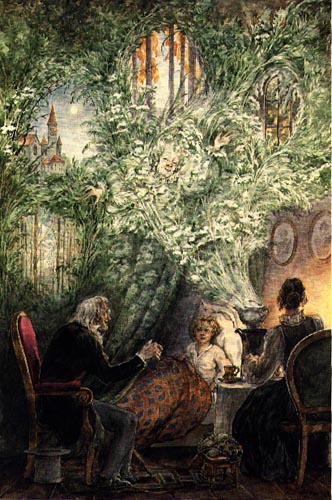
The Little Elder Tree Mother by Hans Christian Andersen (1845)

There was once a little boy who had caught cold; he had gone out and got wet feet. Nobody had the least idea how it had happened; the weather was quite dry. His mother undressed him, put him to bed, and ordered the teapot to be brought in, that she might make him a good cup of tea from the elder-tree blossoms, which is so warming. At the same time, the kind-hearted old man who lived by himself in the upper storey of the house came in; he led a lonely life, for he had no wife and children; but he loved the children of others very much, and he could tell so many fairy tales and stories, that it was a pleasure to hear him.
“Now, drink your tea,” said the mother; “perhaps you will hear a story.”
“Yes, if I only knew a fresh one,” said the old man, and nodded smilingly. “But how did the little fellow get his wet feet?” he then asked.
“That,” replied the mother, “nobody can understand.”
“Will you tell me a story?” asked the boy.
“Yes, if you can tell me as nearly as possible how deep is the gutter in the little street where you go to school.”
“Just half as high as my top-boots,” replied the boy; “but then I must stand in the deepest holes.”
“There, now we know where you got your wet feet,” said the old man. “I ought to tell you a story, but the worst of it is, I do not know any more.”
“You can make one up,” said the little boy. “Mother says you can tell a fairy tale about anything you look at or touch.”
“That is all very well, but such tales or stories are worth nothing! No, the right ones come by themselves and knock at my forehead saying: ‘Here I am.’”
“Will not one knock soon?” asked the boy; and the mother smiled while she put elder-tree blossoms into the teapot and poured boiling water over them. “Pray, tell me a story.”
“Yes, if stories came by themselves; they are so proud, they only come when they please.—But wait,” he said suddenly, “there is one. Look at the teapot; there is a story in it now.”
And the little boy looked at the teapot; the lid rose up gradually, the elder-tree blossoms sprang forth one by one, fresh and white; long boughs came forth; even out of the spout they grew up in all directions, and formed a bush—nay, a large elder tree, which stretched its branches up to the bed and pushed the curtains aside; and there were so many blossoms and such a sweet fragrance! In the midst of the tree sat a kindly-looking old woman with a strange dress; it was as green as the leaves, and trimmed with large white blossoms, so that it was difficult to say whether it was real cloth, or the leaves and blossoms of the elder-tree.
“What is this woman’s name?” asked the little boy.
“Well, the Romans and Greeks used to call her a Dryad,” said the old man; “but we do not understand that. Out in the sailors’ quarter they give her a better name; there she is called elder-tree mother.Now, you must attentively listen to her and look at the beautiful elder-tree.
“Just such a large tree, covered with flowers, stands out there; it grew in the corner of an humble little yard; under this tree sat two old people one afternoon in the beautiful sunshine. He was an old, old sailor, and she his old wife; they had already great-grandchildren, and were soon to celebrate their golden wedding, but they could not remember the date, and the elder-tree mother was sitting in the tree and looked as pleased as this one here. ‘I know very well when the golden wedding is to take place,’ she said; but they did not hear it—they were talking of bygone days.
“‘Well, do you remember?’ said the old sailor, ‘when we were quite small and used to run about and play—it was in the very same yard where we now are—we used to put little branches into the ground and make a garden.’
“‘Yes,’ said the old woman, ‘I remember it very well; we used to water the branches, and one of them, an elder-tree branch, took root, and grew and became the large tree under which we are now sitting as old people.’
“‘Certainly, you are right,’ he said; ‘and in yonder corner stood a large water-tub; there I used to sail my boat, which I had cut out myself—it sailed so well; but soon I had to sail somewhere else.’
“‘But first we went to school to learn something,’ she said, ‘and then we were confirmed; we both wept on that day, but in the afternoon we went out hand in hand, and ascended the high round tower and looked out into the wide world right over Copenhagen and the sea; then we walked to Fredericksburg, where the king and the queen were sailing about in their magnificent boat on the canals.’
“‘But soon I had to sail about somewhere else, and for many years I was travelling about far away from home.’
“‘And I often cried about you, for I was afraid lest you were drowned and lying at the bottom of the sea. Many a time I got up in the night and looked if the weathercock had turned; it turned often, but you did not return. I remember one day distinctly: the rain was pouring down in torrents; the dust-man had come to the house where I was in service; I went down with the dust-bin and stood for a moment in the doorway, and looked at the dreadful weather. Then the postman gave me a letter; it was from you. Heavens! how that letter had travelled about. I tore it open and read it; I cried and laughed at the same time, and was so happy! Therein was written that you were staying in the hot countries, where the coffee grows. These must be marvellous countries. You said a great deal about them, and I read all while the rain was pouring down and I was standing there with the dust-bin. Then suddenly some one put his arm round my waist—’
“‘Yes, and you gave him a hearty smack on the cheek,’ said the old man.
“‘I did not know that it was you—you had come as quickly as your letter; and you looked so handsome, and so you do still. You had a large yellow silk handkerchief in your pocket and a shining hat on. You looked so well, and the weather in the street was horrible!’
“‘Then we married,’ he said. ‘Do you remember how we got our first boy, and then Mary, Niels, Peter, John, and Christian?’
‘Oh yes; and now they have all grown up, and have become useful members of society, whom everybody cares for.’
“‘And their children have had children again,’ said the old sailor. ‘Yes, these are children’s children, and they are strong and healthy. If I am not mistaken, our wedding took place at this season of the year.’
“‘Yes, to-day is your golden wedding-day,’ said the little elder-tree mother, stretching her head down between the two old people, who thought that she was their neighbour who was nodding to them; they looked at each other and clasped hands. Soon afterwards the children and grandchildren came, for they knew very well that it was the golden wedding-day; they had already wished them joy and happiness in the morning, but the old people had forgotten it, although they remembered things so well that had passed many, many years ago. The elder-tree smelt strongly, and the setting sun illuminated the faces of the two old people, so that they looked quite rosy; the youngest of the grandchildren danced round them, and cried merrily that there would be a feast in the evening, for they were to have hot potatoes; and the elder mother nodded in the tree and cried ‘Hooray’ with the others.”
“But that was no fairy tale,” said the little boy who had listened to it.
“You will presently understand it,” said the old man who told the story. “Let us ask little elder-tree mother about it.”
“That was no fairy tale,” said the little elder-tree mother; “but now it comes! Real life furnishes us with subjects for the most wonderful fairy tales; for otherwise my beautiful elder-bush could not have grown forth out of the teapot.”
And then she took the little boy out of bed and placed him on her bosom; the elder branches, full of blossoms, closed over them; it was as if they sat in a thick leafy bower which flew with them through the air; it was beautiful beyond all description. The little elder-tree mother had suddenly become a charming young girl, but her dress was still of the same green material, covered with white blossoms, as the elder-tree mother had worn; she had a real elder blossom on her bosom, and a wreath of the same flowers was wound round her curly golden hair; her eyes were so large and so blue that it was wonderful to look at them. She and the boy kissed each other, and then they were of the same age and felt the same joys. They walked hand in hand out of the bower, and now stood at home in a beautiful flower garden. Near the green lawn the father’s walking-stick was tied to a post. There was life in this stick for the little ones, for as soon as they seated themselves upon it the polished knob turned into a neighing horse’s head, a long black mane was fluttering in the wind, and four strong slender legs grew out. The animal was fiery and spirited; they galloped round the lawn. “Hooray! now we shall ride far away, many miles!” said the boy; “we shall ride to the nobleman’s estate where we were last year.” And they rode round the lawn again, and the little girl, who, as we know, was no other than the little elder-tree mother, continually cried, “Now we are in the country! Do you see the farmhouse there, with the large baking stove, which projects like a gigantic egg out of the wall into the road? The elder-tree spreads its branches over it, and the cock struts about and scratches for the hens. Look how proud he is! Now we are near the church; it stands on a high hill, under the spreading oak trees; one of them is half dead! Now we are at the smithy, where the fire roars and the half-naked men beat with their hammers so that the sparks fly far and wide. Let’s be off to the beautiful farm!” And they passed by everything the little girl, who was sitting behind on the stick, described, and the boy saw it, and yet they only went round the lawn. Then they played in a side-walk, and marked out a little garden on the ground; she took elder-blossoms out of her hair and planted them, and they grew exactly like those the old people planted when they were children, as we have heard before. They walked about hand in hand, just as the old couple had done when they were little, but they did not go to the round tower nor to the Fredericksburg garden. No; the little girl seized the boy round the waist, and then they flew far into the country. It was spring and it became summer, it was autumn and it became winter, and thousands of pictures reflected themselves in the boy’s eyes and heart, and the little girl always sang again, “You will never forget that!” And during their whole flight the elder-tree smelt so sweetly; he noticed the roses and the fresh beeches, but the elder-tree smelt much stronger, for the flowers were fixed on the little girl’s bosom, against which the boy often rested his head during the flight.
“It is beautiful here in spring,” said the little girl, and they were again in the green beechwood, where the thyme breathed forth sweet fragrance at their feet, and the pink anemones looked lovely in the green moss. “Oh! that it were always spring in the fragrant beechwood!”
“Here it is splendid in summer!” she said, and they passed by old castles of the age of chivalry. The high walls and indented battlements were reflected in the water of the ditches, on which swans were swimming and peering into the old shady avenues. The corn waved in the field like a yellow sea. Red and yellow flowers grew in the ditches, wild hops and convolvuli in full bloom in the hedges. In the evening the moon rose, large and round, and the hayricks in the meadows smelt sweetly. “One can never forget it!”
“Here it is beautiful in autumn!” said the little girl, and the atmosphere seemed twice as high and blue, while the wood shone with crimson, green, and gold. The hounds were running off, flocks of wild fowl flew screaming over the barrows, while the bramble bushes twined round the old stones. The dark-blue sea was covered with white-sailed ships, and in the barns sat old women, girls, and children picking hops into a large tub; the young ones sang songs, and the old people told fairy tales about goblins and sorcerers. It could not be more pleasant anywhere.
“Here it’s agreeable in winter!” said the little girl, and all the trees were covered with hoar-frost, so that they looked like white coral. The snow creaked under one’s feet, as if one had new boots on. One shooting star after another traversed the sky. In the room the Christmas tree was lit, and there were song and merriment. In the peasant’s cottage the violin sounded, and games were played for apple quarters; even the poorest child said, “It is beautiful in winter!”
And indeed it was beautiful! And the little girl showed everything to the boy, and the elder-tree continued to breathe forth sweet perfume, while the red flag with the white cross was streaming in the wind; it was the flag under which the old sailor had served. The boy became a youth; he was to go out into the wide world, far away to the countries where the coffee grows. But at parting the little girl took an elder-blossom from her breast and gave it to him as a keepsake. He placed it in his prayer-book, and when he opened it in distant lands it was always at the place where the flower of remembrance was lying; and the more he looked at it the fresher it became, so that he could almost smell the fragrance of the woods at home. He distinctly saw the little girl, with her bright blue eyes, peeping out from behind the petals, and heard her whispering, “Here it is beautiful in spring, in summer, in autumn, and in winter,” and hundreds of pictures passed through his mind.
Thus many years rolled by. He had now become an old man, and was sitting, with his old wife, under an elder-tree in full bloom. They held each other by the hand exactly as the great-grandfather and the great-grandmother had done outside, and, like them, they talked about bygone days and of their golden wedding. The little girl with the blue eyes and elder-blossoms in her hair was sitting high up in the tree, and nodded to them, saying, “To-day is the golden wedding!” And then she took two flowers out of her wreath and kissed them. They glittered at first like silver, then like gold, and when she placed them on the heads of the old people each flower became a golden crown. There they both sat like a king and queen under the sweet-smelling tree, which looked exactly like an elder-tree, and he told his wife the story of the elder-tree mother as it had been told him when he was a little boy. They were both of opinion that the story contained many points like their own, and these similarities they liked best.
“Yes, so it is,” said the little girl in the tree. “Some call me Little Elder-tree Mother; others a Dryad; but my real name is ‘Remembrance.’ It is I who sit in the tree which grows and grows. I can remember things and tell stories! But let’s see if you have still got your flower.”
And the old man opened his prayer-book; the elder-blossom was still in it, and as fresh as if it had only just been put in. Remembrance nodded, and the two old people, with the golden crowns on their heads, sat in the glowing evening sun. They closed their eyes and—and—
Well, now the story is ended! The little boy in bed did not know whether he had dreamt it or heard it told; the teapot stood on the table, but no elder-tree was growing out of it, and the old man who had told the story was on the point of leaving the room, and he did go out.
“How beautiful it was!” said the little boy. “Mother, I have been to warm countries!”
“I believe you,” said the mother; “if one takes two cups of hot elder-tea it is quite natural that one gets into warm countries!” And she covered him up well, so that he might not take cold. “You have slept soundly while I was arguing with the old man whether it was a story or a fairy tale!”
“And what has become of the little elder-tree mother?” asked the boy.
“She is in the teapot,” said the mother; “and there she may remain.”

Saturday, February 18, 2012

Childhood Charms

Precious sister
you gave to me the center of my heart.

Born on a below zero day.
I sat in the car with daddy waiting.
I had no idea how much I needed
you.

Playmate of school, Barbies and
Little People,
bicycles and iceskates,
shared sweaters but never shared shoes.

You were the
Companion of my imagination and
my whispy-haired friend.
I always loved you.

Like charms on my bracelet and yours:

You were pianos and carefulness,
crazy concoctions and
sturdy things that made a difference.
I was carousels and trees.
Incongruousness, difficult,
and hard to pin down.

But one thing was constant
throughout my life to yours,
I could never have loved you more.

I should have told you before
of my gratitude for your charm.
Children don't need to say,
they just know.

But time has unwoven us,
and I now tell you in imperfect words.
You were my gentle light.
You gave me a reason to feel love.

You gave me giggles and stories,
and protectiveness that you hated.
You gave me someone to adore.

It was so easy to cherish you,
little sister,
and to want the best for you.

Like charms on my bracelet and yours:
hearts, and happiness and love.

Saturday, February 11, 2012

Rose's Son Has Cancer


I have friends that are precious to me, but that I have never met.
They came to me by Divine Collision.

God knew Jennifer,
God knew Rose,
so that through social-network-creation, we became
friends.

In the fullness of time,
not knowing it was intended from the beginning,
our lives were twined together so that I could be
friend to Rose,
a mother with a son who has cancer.

Now I have a son with cancer too, his name is Ben.
And Ben is a father himself, and will be so again for the third time soon.
And together with Rose I hold up the moon in the night above his bed
so that the scary monsters stay away and he may sleep,
so that his arms will be strong to hold his arriving child.

We know a lot about scary monsters,
and diapers,
and spilled milk,
and Bandaids,
and grass-stained jeans,
because
we are mothers.

We know that tears happen to boys as well as girls,
that frogs are delightful,
that you can never pick up all the Legos,
and that girls who have cooties now, will be the reason for car keys to be needed soon.

When we became mothers, we joined a great circle of Divine Daughters that has spiraled from the First Mother
through all mothers to join us together as one.
Through water,
through blood,
through sweat,
through agony personal, and yet known by the circling Daughters of dawn,
we brought forth our sons.

We are one mother.
They are one son.
My Ben has cancer, and my heart is not strong.


Strength comes to those who need to race.
Our strength will carry us through this because we were the champions of 12 and 2 and 4 and 6,
and we never slept at all during the week of the flu,
and because we could find the lost socks,
and keep the kite in the sky,
and make spaghetti five different ways,
and sit through the game not shouting anything (too) embarrassing.

Our strength comes from the waiting and the dreaming during the months that our son grew inside our body's nest of flesh and love.
We grew so beautiful and we grew so wise
and we grew strong to greet the needy mouths and fingers and imaginations of our son.

And my son Ben's mother Rose,
now,
has the strength of the Divine Daughters as her labor continues to intensify and she keens with the pain.
And I and all the others will be her strong arms of encouragement
and midwife her through her pain.

Rose has a son who is my joy. He has cancer now. His name is Ben.

Friday, January 27, 2012

We Should Have Danced

Awakened,
I hear all the old songs in new ways

What beast is it that has flow into my ear?

Surrounded by the suffering we've inflicted upon ourselves
I face the curved surface that holds my knowledge and see the myopic distortion

We were invited to dance

Don't you know that the Songs created the world?
Love songs
Laments
Yearning tunes
Angelic refrains
Ancient sounds of origins
the songs of birth, life
and death
Sung from a place deep within the center
of our hearts

Why did we pick up a stone and throw it through the center of the love?
and break the light that sang the Songs that made us whole?

We are destruct-ors when we could have been creators

we should have danced

Tuesday, November 22, 2011

Wednesday, November 2, 2011

Starting in the Middle and Working from the Center Out

I named this blog from my interest in sewing, and I just realized I've virtually never mentioned a thing about sewing in any form. It's about time I remedied that.

I was born with gracious stitches all around me. All the women in my family were amazing seamstresses and craftswomen with fabric and thread. I was brought home from the hospital in hand-stitched receiving blankets, laid in my crib in a room filled with home-sewn curtains and quilts and blankets. My first wardrobe, and for most of my childhood, I wore hand-created garments by my mother and grandmothers; little dresses with my Grandmother Lorraine's beautiful stitching and hand-smocking on them,
mittens and socks knitted with love, and jackets, hats, scarfs and ponchos crafted just in my size. I slept under heirloom quilts and laid my head on hand-embroidered pillow cases. My bedroom walls were hung with hand-stitched treasures, including a framed Noah's ark crewelwork piece with all the animals, and my bed was strewn with handcrafted dolls, stuffed animals, and crocheted toys. My childhood was surrounded by humble and practical artistic beauty, and hand-stitched love.
I naturally grew up with a needle between my fingers.

I started with simple stitches of my own design on scraps of cloth from my mother's sewing basket. Gradually I worked my way through the different sewing techniques: needlepoint, cross-stitch, huck weaving (Swedish embroidery seen below),all kinds of embroidery, crewel, counted-cross stitch and quilting. I learned to sew with a machine and kept myself and my dolls in simple little garments. I remember in particular, making my own complete outfit, a top and slacks, just in time for it's inaugural wearing on a 5th grade class field trip! I was in heaven.

As a child I never went anywhere without either a book to read or a project to stitch, and preferably both.
There are many life lessons that come from a childhood surrounded by multi-colored threads and fabrics, but for me the most profound is probably that sewing is seldom a linear thing. You can't quilt a beautiful quilt by starting at the beginning and working in a straight line to the end. Sewing and stitching beautifully, almost always consists of starting somewhere in the middle and working from that center out. As much as it may seem logical before actually trying it, creating a satisfying and beautiful piece of stitching is never a linear, top to bottom task.

Let me try to explain. Think of something that seems very linear to the eye, for instance the huck weaving example above. It sure looks to the eye as if you start at the edge and stitch horizontally right across the bottom of that towel. "Hucking", done on huck toweling with a special fabric surface for the stitches to be "woven" under, is actually begun right smack in the middle of the towel. You fold that baby in half, find the middle, and stitch a middle guide stitch to be removed later so you don't lose track of the middle as you sew! You then work your stitches out and away from the center, returning to the center point every time you need a reference. This is the only way a pattern will be sure to center and end on both sides with matching edges. If you were to try any other method, you'd either end up lopsided, or you'd end up with taking out lots of stitches (a subject for another blog on another day!)

The same is true with quilting. Start in the center as you piece together your pieces. Usually pieced quilts are done in small sections, and the sections (worked from a center-point out if they artist knows what they are doing) are then brought together in a larger and larger piece, consistently working from the center out.

This is even true when constructing a garment of clothing. "Now a shirt can't be started from the center," you argue. "Start at the top of the top and work to the bottom of the bottom... collar first, hem at the bottom last," you might think. Wrong. You will have nothing your pet boa constrictor will be even able to slither into if you follow that method. You start always with constructing the center of the garment, and work up and down from the center, working in a logical progression so that pieces are stitched on in a manner that allows the next piece to be attached. Example. You attach a yoke of a shirt to the body and the collar to the yoke, before you can begin to attach the arms, the front placket or sew up the sides. You must have a center from which to anchor the work that will flow out of it.

The center is the anchor of all that we do as we create art and fashion from needles, thread and fabrics. You can choose the most amazing fabric combinations, use the most complex sewing techniques, but if you fail to understand the "chord" that will makes the different parts into a "symphony," the piece you create will never be artistry.

As I live my life, I am more and more aware of just how much this is the basic reality of my life's melody and rhythm. I don't see the world from the edges in, or linearly, from top to bottom. I see the middle of issues, the center of the picture, the soul, and then work from that point out to the edges to clarify the picture in my mind. I tend to think that maybe this is a God-gift. I tend to think that maybe God sees the world from the center of its being too... from the center which is God's self, and that God works from that point out, to understand and view all of us.

God is the mirror in the center of our being that our person is reflected out from. The center of us is the center of God's self, and we are seen by God from that center-point. We are seen by God from the center of our hearts, minds, bodies, needs, hopes, dreams, challenges, heartbreaks... outward. God sees us from the center that is God within each of us. We are only capable of seeing that same center in each other if we seek in grace not to look at each other linearly; from logical top-to-bottom, front-to-back, outside first. We see only the individuals around us, if we see them with the eyes of love, compassion, kindness, forgiveness and hope.

Our center is our foundation. What we are built out from. What we fail to attach well onto our central foundation, what we pick up as trash and debris from life, what injuries we do to the externals of our foundation, what evil bits we glue onto our central selves by choice, do not still, in their whole, destroy the inner beauty of the core that God built us from, because that core is Godself.

What I hope to do with this blog, with this life that is mine, with the children I have been given to raise, with the relationships that I have the privilege of being a part of, within the churches I serve, with the bits and pieces of my life and all its hours, is to sew the most beautiful gilded patches I can, with the most gracious thread I can find, onto the lives of the people I encounter. It is my intention and dream, and always has been my joy, to take the beautiful foundations of thread and fabric, and create with them objects of beauty that build from the center and the heart of their reality. It is my dream to stitch away the broken spots of people's lives. strengthening them and taking away their ugliness, revealing spots of rare beauty that reminds each person with pride, that God has not forgotten them, but seeks to bring out that which is their center and create a great masterwork of their life.

That is my dream.
With wool and silk,
floss and thread,
paisley-ed and patterned,
fringed and gilded bits and pieces,
to see the middle of God's great handiwork and work from that center out to patch with gracious threads the broken hopes of the world.

Oh Beautiful Seamstress of the Eternities, hear my prayer.

Sunday, September 25, 2011

Sexy Boots on Clergy Women

If you click on the title of this post, it will take you to a very interesting reflection by Michael and Anthony Emerson on U2s "Sexy Boots" (also printed below). I love the encouraging word coming from a blend of Bono's understanding of what the church can be, and Anthony and Michael's "exegesis" of this song. I have a concern though, and I think it's a very significant one. It's not a criticism of the writing of Emersons so much as it is a whopping big Aha that arises out of their thoughtfulness here.... Why, when they get to the phrase "Women of the future hold the big revelations" do they diverge from their explicit dealing with the text of the song, and start talking about "Resident Aliens" which has nothing to do with that line? Are we generally uncomfortable with that line in the church? I think we are. I think that we are not willing to imagine that Bono may be right, and that the women of the church do hold the message of how beautiful the church can be in their minds, hearts, experiences and spirits. I am concerned that we are afraid to discuss this possibility in the church. I fear, that instead of welcoming women's insights and thoughts, indeed wisdom, we are in fact eager to shut that conversation down if it ever rises up. Women have been the majority figures in the church almost since its inception, and yet we have still, in the year 2011, not been welcomed to share our vision of the church's future in very many liturgical or theological spaces. We are the silent/silenced majority. Women DO know how beautiful the church can be, and have something very important to add to the conversation. Is Bono the only one who recognizes this fact and will include us in the dialogue? Here's what the Emerson's have to say. See what you think.


U2's “No Line on the Horizon” has been one of their more misunderstood albums. The most misunderstood song of the album is “Get On Your Boots.” Here is a snippet.

The future needs a big kiss
Winds blow with a twist
Never seen a moon like this
Can you see it too?
Night is falling everywhere
Rockets at the fun fair
Satan loves a bomb scare
But he won't scare you


“Get On Your Boots” is is bombastic and urgent, sleek and fast-paced. But more than anything it’s a powerful message of hope to the church. Take, for example, the first line, “the future needs a big kiss.” What entity would be able to impact the future with a kiss (curious choice of words, right)? How about the bride of Christ, the church? The future needs the church because of the next six lines: the winds are blowing, the moon (a motif of confusion and evil) is up, night has fallen, and Satan is trying to frighten us. Why would Bono have the boldness to tell us that Satan shouldn’t scare us? Remember Matthew 16:18: “On this rock I will build my church, and the gates of Hades will not overcome it.” Therefore, get on your boots. In other words, get up and do some work in this dark world because God has empowered you to do so.

You free me from the dark dream
Candy floss ice cream
All our kids are screaming
But the ghosts aren't real
Here's where we gotta be
Love and community
Laughter is eternity
If joy is real


“You free me from the dark dream” suggests the church is saving the lost. Then we see giddy happiness in the second line with paradoxical, light-hearted objects (happiness doesn't make sense). The third and fourth lines convey the same idea as the last two lines of the first stanza. Things become clearer when the necessity of community is brought in. Laughter is a godly and reasonable thing if there really is a happy ending awaiting us. We can fight the evils of this world with light hearts because we are fighting within a vibrant community of Spirit-filled people.

You don't know how beautiful you are

You, the church, don't understand how made-in-the image-of-God awesome you can be. You can have perfect joy and community! So get on your boots and be boldly beautiful!

Women of the future hold the big revelations
I've got a submarine
You got gasoline
I don't want to talk about wars between nations


It is striking how near the message of this song is to Hauerwas' and Willimon's “Resident Aliens.” Since we no longer live in a Christian culture, the church is free to live as a distinct people once again. We are to impact the world through our colony, not as we have been doing since Constantine: through the government. The holy community that we are supposed to be can astound the world by how beautiful we are and how much love we show the world. The problems and conflicts of this world will not be solved by mere mortals. Only through the church can the world be truly redeemed. Get on your boots!

Let me in the sound!

Where did this come from? Acts 2. “Suddenly a sound like the blowing of a violent wind came from heaven . . .”. The birth of the church. If you want more proof, look at John 3:5-8, where Jesus compares being born of the Spirit to the sound of the wind – we can’t tell where it's going. It's probably not a coincidence that both the sound and birth are themes throughout “No Line on the Horizon.” The sound is representative of the Spirit, the Lord of the church.

There are people in the world who want in! Get on your boots, and let the church get to stepp’in!

Michael O. Emerson is the Cline Professor of Sociology and the Director of the Center on Race, Religion, and Urban Life at Rice University in Houston, Texas. His son, Anthony Emerson, is a sophomore at Ouachita Baptist University in Arkadelphia, Arkansas.

Saturday, September 17, 2011

Clergy Resume, Day 7087:

Can comfort the sick; preach the Bible; teach and capture the imagination of any age on virtually any topic of faith and life; sit with the elderly; hold new babies when they cry; attend potlucks and compliment all the cooks; organize anything that needs organizing except for our desk; hold people together in crisis; help them figure out responses to their daily problems; read 8 books simultaneously and apply them all in one 20 minute sermon; conjure money out of thin air to meet the budget; know how to read music; play hand bells without practicing the part when someone gets sick; do light comedy; interpret ancient texts and John Wesley; be cool enough for teens to like you; hold conversations on the phone and with three other people in your office simultaneously; never get 8 hours of sleep or 2 days off in a row; write articles without grammatical errors; stay physically fit and attractively dressed at all times, day or night; conduct meetings; drive your car in fog/sleet/snow in the middle of the night to unmarked roads and back; arrive at meetings across state at 8:00 am and attend meetings at the church until 10:00 pm the same day; maintain your home, family, cars, health and pets on 10 hours a week at most; and always be at the office when the phone rings or at the shut-in's home when they think of you... we're unemployable in any other field except the church!!! :)

Did I forgot to mention: dealing with dueling musicians; a Trustees vs. United Methodist Women's scheduling conflict; a new leak in the sanctuary roof; overflowing toilets; the wrong color paraments on the altar; testy staff because the Sunday bulletin isn't complete and it's Wednesday; and then walk into the funeral service on time, perfectly dressed and hair in place, with a perfect meditation on the life of the deceased an hour before you have to undergo a dental surgery... then be back, rested, pressed and well enough to function the next day because you have Charge Conference that night after a wedding rehearsal! Oh, and don't forget what the 39 different people whispered to you about their Aunt/cousin/best friend in Florida on the way out of service on Sunday because you are going to be tested on that! But don't go looking for a job in the secular world, we are unemployable. (Boy was this therapeutic!)

Thursday, September 8, 2011

What is Happening to Mommy?


My 11-year-old went to WalMart tonight with me, and she asked to see the toys. I've now been introduced to the latest craze in 5th grade... Monster High Dolls (mostly very skinny girl monsters, but a few boy monsters too.) She did NOT ask, but she has been hanging onto birthday money for awhile, so I let her pick one out... I actually asked her if she wanted to. We looked them all over carefully and found one sufficiently clothed. It's a mummy Cleopatra.

Now I'm wondering what came over me? This is not like me at all to suggest my children buy something they are a little bit wistful about. I help and encourage book buying from time to time, but not toys, especially not emaciated, over-tall, sassy looking, vaguely sexy, monster dolls! (Then again I never thought I'd do lots of things as a mother and have.) We certainly never had a Bratz doll in this house! But this situation has sort of really surprised me.

I'm wonder if I'm starting to grieve my children's growing up? (Surely not me! I'm the stalwart, no-tears-mom type, who expects a lot from my kids and gets it most of the time. I'm not a mushy, push-over mom.) But, my oldest is about to become an adult in 22 days. (That's a reality shock if I ever had one before.) I have two in high school now. (How did that happen?) And hardly anyone asks to go to the toy department any more.

Maybe I got caught in her sweet conversations somewhere, (NOT asking for one herself, mind you) of her friends playing with their Monster High Dolls at recess at school. Maybe I feel guilty because we say no to SO much the children would enjoy and even benefit from; like a Labor Day idea of swimming rained out because of the weather; two parents, three jobs, not enough money and tired all the time; seldom time to cook a family supper and sit down together; events we can't squeeze in because of work demands; weekends we can't do what other families do because we "have to work"; not home most evenings to put them to bed; having moved with the ministry so often that one child has actually attended 7 different schools in 9 years; etc., etc., etc...and they are all growing up SO fast!

I don't know what it boils down to, but twiggy little "Cleo" with sparkly hair, pouty mouth and 10-inch-heel equivalent bedtime slippers represents a whole lot more than the $9.97 that was paid for her. She made my youngest very, very happy, and I guess maybe I'm just not wanting to lose that magic yet... the simple magic of a small gift lighting up my child's eyes with such happiness. It will all be gone so soon.

Sunday, September 4, 2011

Women by Adrienne Rich

My three sisters are sitting
on rocks of obsidian.
For the first time, in this light, I can see who they are.

My first sister is sewing her costume for the procession.
She is going as the Transparent Lady
and all her nerves will be visible.

My second sister is also sewing,
at the seam over her heart which has never healed entirely.
At last, she hopes, this tightness in her chest will ease.

My third sister is gazing
at a dark-red crust spreading westward far out on the sea.
Her stockings are torn but she is beautiful.


Saturday, September 3, 2011

Sweater Shavers, Fuzziness, and Thoughts on Getting Moving in the Right Direction Again


I pulled on my favorite red sweater with one hand and reached for the sweater shaver with this other. You know a sweater shaver? You get them in odd places like fabric and craft stores, they look like small men's electric razors and use one AA battery to power them which is induced into a chamber much too large for its purpose. As a result, the sweater shaver actually shaves for only a few minutes at a time before you accidentally jar the battery out of position, have to open the sliding back to adjust the battery, and try again. I bought this sweater shaver about the time I acquired my husband, late 80s or early 90s, and it still holds its place of honor in my life. It is an honorable job, is it not, to restore fuzzed-out sweaters to their rightful de-fuzzed state?

I had erroneously failed to "turn inside out" my favorite red sweater at it's last washing, and now it was covered with towel lint and other unidentifiable fuzziness. The sweater shaver was the only way forward. So I shaved away, all over myself. I prefer the methodology of putting the sweater on first to trying to shave the sweater on a table, because the tendency is for the sweater to stay put on your body and not so much on a table.

Sweater shaved, I was off to my best caped crusader impression of the day.

About half-way through the day, it suddenly dawned on me that I had neglected to shave the fuzziness off the back of my sweater. Now that was probably obvious to you when you started reading this, but it wasn't so obvious to me from within my red sweater. I mean, if you look into a mirror, facing forward, I looked pretty good. But if you were following me around through my day, I was probably a little natty-looking from behind. Nothing to be done about it at that point, so I continued forward, and tried to forget my fuzzy rear-view.

As the day wound down, and I finally removed my sweater for the day, I could see that in fact there was a quantity of fuzz on the back of the sweater as I had suspected all day. Not one person had said a thing about my two-sided sweater dilemma, either.
I suspect that is because I am a whole lot fuzzier all the time than I like to admit, and my sweater was saying nothing others didn't know about me already.

I have for the past 20 plus years taken a certain amount of pleasure in being able to articulate my direction and purpose in life. I have been on a journey of faith that has been more or less clear to me, as I have both squished through the muddy places on the road and shimmered along the smoother paths. This rear-fuzzed sweater has pointed out to me that my life is less obvious and fuzzier than I had previously thought. I had just been looking at the "front" part of my life and not realized what was happening "behind"...looking through the dim glass and not realizing it.

Now having noticed how fuzzy my sweater-back has become, I find I have to choose. Do I remove my favorite red sweater, turn it around and pop it back on backwards so I can defuzz the back which is now the front? How disturbing that will be to those around me during the process. Am I moving forward with my back to the future or backward with my front facing where I've been? That seems unmercifully challenging, not to mention confusing, just so I can remove some fuzziness in my life.

Or do I remove my sweater completely. Stand there partly naked and lay the sweater, face-down on the table to get at the fuzz, accepting that I will have to chase the sweater across the table in a number of directions to get the job done? Is the nakedness and slipperiness of this solution any better way forward at all?

In order to keep your sweater free from fuzz, you must always remember to turn it inside out before you wash it, and preferably wash it by hand. I have failed, in several ways, the better angels of my pre-Vatican II upbringing that tried to teach me this.

Failure to meet some of the basic expectations of my sex because of the exciting new thinking of the 1970s led me to believe that I was a child of a new generation that could skip the tediousness and time-consuming efforts of the times gone by, and go on with something new. We were sure we could, both men and women, be interchangeable and wear unisex, machine-knit, polyester garments that would no longer require the attention to laundry techniques of earlier times. It was all to be easier, better, more successful. We would not fail.

I adapted myself to this new philosphy. Nothing short of total transformation was required from the way I had been raised. Learning new languages was mandatory. Putting off the generosities, kindnesses, sensitivities, carefulness, and taking on the golden and steel-edged ways of a new course in the world that was harsher and more careless about all things, especially precious things. But by radical change and transformation, a journey forward full of great success was guaranteed; unisex, un-frilled, slightly wrinkled but NOT fuzzy and surely much more highly successful than ever before.

Except for one thing. I never lost my fuzziness. I wasn't unisexual at all. My new golden-steel exterior, so blessed by grace and superiority to that which my former self had been, was fuzzy still. Very, very fuzzy. I forgot you can't put any sweater in the laundry, no matter if it is wool, cashmere, wood or steel, and expect it to come out fuzz-free if it's not first turned inside out. Fuzz on what is supposed to be strong and unbending is hilarious. It is even a punishable offense.

So here I am. Strong in all the wrong places and fuzzy beyond ability I have to remove the fuzz for myself without nakedness. I couldn't change the essential me by changing my philosophy, my personality, my commitments or by becoming unisex.

There is always a sort of restlessness that accompanies the cross-crossed lives of Jesus' followers. We carry the cross in a way that is uncomfortable and even painful to bear, and leaves us stumbling with the limitations we've accepted for our lives. We yearn to be off the cross and free to walk upright in complete acceptance and love by all we meet, instead of bent by the burden. Others see our cross-crossedness though, and crossing themselves, step to the other side of the road, clear that this burden is not one they want to help carry. We grow weary, tired of our discomforts and challenged by the unwillingness that our fellows feel toward helping us with our burden. They close their doors as we stumble by.

That is when it suddenly is clear how very fuzzy this all is. How, with our eyes front, we've missed how fuzzy this journey has become behind our backs. Where we had once seen through a glass clearly, we now need to see that no amount of AA batteries in our sweater shaver will ever really remove the fuzziness at all.

I'm thinking now about what it will take to get the fuzz off me, or if it ever will come off. Maybe I was meant to be fuzzy. Maybe you were meant to be fuzzy with me. Maybe we are all supposed to be fuzzy, and it's denuded that wrong.

Maybe we've been looking at the cross the wrong way. Maybe we have been clinging to it like it was life itself, when in fact it was the instrument of tens of thousands of torturous deaths. Maybe we have embraced and carried an instrument of torture when what we should have been embracing and carrying was fuzzy sweaters to warm a chilly world. Maybe the fuzz is of God, and that is what Jesus came to show us. Jesus seemed to really love fuzziness, our fuzziness, our confusion, our feebleness, our weakness, our failings. They all seemed pretty acceptable to Jesus and he seemed a lot less comfortable with the clean-shaven and perfect world.

What if I do start to wear my sweaters backwards? Maybe I should pull open my battery-operated de-fuzzer and start sticking fuzziness back on. What if I do start to value the fuzziness in me the way I have long valued the fuzziness I see in others?

Wait!
What was that? I just said it... I have long valued the fuzziness in others.
I have long valued the fuzziness in others!
I have long valued the confusion, the feebleness, the weakness, the vulnerability in others as a sign of their best selves, and yet I did not value it in myself. I have been loving the wrong side of myself! I have been looking for only the clean-shaven strength in me...

when the fuzzy, weak, sensitive, wholesome, tedious,
kind and sexualness of me have been actually better all along.

Saturday, August 6, 2011

From the Blog Archives: A Commentary on "Big Baby", June 25, 2010


I saw Toy Story 3 tonight.

I, along with many of my friends, have been taking our children to see Toy Story movies since they first came out in 1995. My oldest son was immediately attached to Woody and Buzz, and we were "sell out" parents almost before we knew it, lugging "Bugs Biteyear" literally everywhere we went for years. Woody was easier, and fit better into carry-bags, but Buzz and Woody were a team, and had to go in tandem. We loved Buzz and Woody with our son, and eventually added a Bugs Biteyear sheet set and pillowcases, and a Bugs Biteyear sleeping bag. Pixar got us early, and Buzz and Woody became very literally the first big "give in" to mass media marketing for us. We never regretted it.

In true Toy Story form, Buzz lost pieces and parts of his famous spaceman suit, and Woody eventually wore out his voicebox and string, and became a much sought-after "groom" for our son's little sisters' doll weddings. Buzz and Woody still inhabit some crevice in our house, at the moment unknown to me, and probably always will be a part of our lives; as toys that the grandchildren will eventually share. But with the release of Toy Story 3, I find I am moved by an entirely new character. Big Baby.

Big Baby is a solitary character, as Toy Story 3 reveals. Once much loved, Big Baby is accidentally lost to her "mommy". Big Baby is left believing herself to be defenseless and subject to the authority figure, and more beloved lost toy, Lots-O'-Huggin' Bear (Lotso for short). Big Baby follows Lotso everywhere, and eventually, when Lotso's love for his child turns to hatred at his abandonment, Big Baby is turned into a hate-filled enforcer for Lotso's power and hate-filled schemes. Big Baby is cast into the role of a dumb, unfeeling goon, left with only doing the bidding of Lotso and his cronies.

Big Baby isn't a mutant figure as in the earlier Toy Story movies, where whole toys are disassembled by Sid, the child-next-door, and grotesquely reassembled. Big Baby is instead a once-beautiful, brilliantly blue-eyed baby doll, a whopping 18 inches tall, that once wore a beautiful dress and bonnet and a necklace proclaim her "parentage". By the time we catch back up with her, now presumably years after her loss, her once beloved vinyl and fabric body is naked, one eye is broken, and she has been permanently disfigured by the markers and paint of over-zealous child playmates. Her sweet baby mouth, now expressionless.

As you look at her promo picture, you see just how desolate her reality has become. At first she looks just like dolls we and our daughters have played with and lost the clothes for. Hundreds of naked babies just like her inhabit toyboxes and church nurseries everywhere. But pictured on a stark black background, black markered toenails, dirty, Big Baby is soon to become in our imaginations, too big, too unattractive, too dirty and too scary to be lovely or loveable anymore.

My immediate response to Big Baby was strong. She had been told she was ugly. She had been told she was unworthy and unwanted. She had been told she was not smart enough, and not important enough, and she was made to believe she didn't count. She was just a baby doll, a too-tall baby doll, and not a more valued "boy toy" or a Barbie. So, she turned to the only form of affection left for her...she found acceptance as a hater and enforcer with Lotso's "Boys". Big Baby became the biggest, creepiest "monster" of the movie.

There were other monsters in Toy Story 3, monsters that were made to be monsters and fuel childhood imaginations. But not Big Baby. She was meant as a toy for cuddling, loving, caring for, and nurturing. Without the good things she was created for, she became a tool for hatred and evil.

As I watched the movie, I was compelled immediately to want to go and save Big Baby. I wanted to rescue her and take her home and clean her up and make her a beautiful dress and name her and keep her forever. But most of all, I wanted to reprogram her dreadful self-concept. This baby doll was "real" for the moments of the screen filling my senses, and she was so damaged. It was for her, and not for the growing-up subjects of the movie, for which I cried.

Perhaps it's a case of "you can grow a girl up, but you can't take the girl out of the woman" or some sort of normal nurturing instinct in this mother-of-three that made me fill with tears. But what really fills me with sorrow as I reflect on Toy Story 3, is how accurately it portrays the reality of so many of us, whether we're at the point of admitting it or not. Big Baby is a victim of the highest magnitude, and in Big Baby, I see all my worst fears for my children represented:

First, Big Baby is a victim of accident. She has been accidentally lost to her mommy, who loved her, valued her, played with her, and needed her. What parent does not fear most, the possibility of being unable to protect their child from injury or death? The most traumatic nightmares for mothers during pregnancy, when nightmares are common, often includes a child just out of her reach, unable to be protected and saved. That is Big Baby; a child whose mother could not save her, leaving her emotionally scarred and damaged.

Second, Big Baby is left to fend for herself, no longer a named being. She is forced into the role of a nobody, a role which completely redefines and transforms her. I have traveled this way myself, and as I face the future with my children who increasingly walk their own way, I fear they too will not have the friends and community around them at some point that helps them maintain their sense of positive value and self-worth. I lost my own personhood early in life, and have spent the adult years of my life trying to re-establish what I had stripped from me. It's been a long, terrible journey, and one that I would give my life to keep anyone else from ever experiencing. (That is why I am in the ministry...to try to help save people's lives from the dreadful hell of self-loss.) That is why tears filled my eyes for Big Baby.

Three, Big Baby is turned into a hater, by the only ones she believes she can depend on, and she subsequently is unable to be recognized for the truly loveable, sweet, innocent,capable, full-of-potential being that she is. Big Baby is what the Lotso Boys decided she is, a monster enforcer, without soul. A "thing", not a "being".

I think this matter stands for itself. How often are we redefined and our real personhood denied us by the forces around us? How often are our vulnerabilities exploited, and are we forced to take on false realities in order to survive? I have, with every fiber of my being, attempted to "immunize" my children from the forces of the world that would deny them their genuine God-graced personhood with the elaborate, unique and amazing personalities that God has given them. I actually grieved to see this same violence inflicted on Big Baby.

The main plots of the story...growing up, letting go, deciding on the future and how to reconcile it with the past, are all hard enough, and important. But they feel a little like emotional window-dressing to me by comparison to the truly important issues that I see in the character of Big Baby. Was I satisfied with the ending for Big Baby (which I will not reveal here if you haven't seen the movie yet)? Yes and no. She was still naked, still without a name, and still was not a "precious" toy as all of Andy's toys were. But, on a positive note, she was obviously aware of having had a different past than the one that she had been reprogrammed to believed by Lotso, she was cared for, and her needs as an individual recognized.

Have I read too much into this movie? Perhaps. Will I see the movie differently the next time I watch it having stated these thoughts electronically? Probably not. Maybe I'm just a case of a woman who once found true joy in the toys of her childhood, and over-sees in Big Baby a being that just wants to be loved. Maybe I'm over-identifying with metaphors about inanimate objects!!! I guess I leave that for you to decide. Whatever you think, I pray for you, your children, and all of our world's children, that there comes a time where not a person every has to be Big Baby